Blog Feed

Storyteller Figure 100/800 CE

Ameca Valley, Jalisco, Mexico

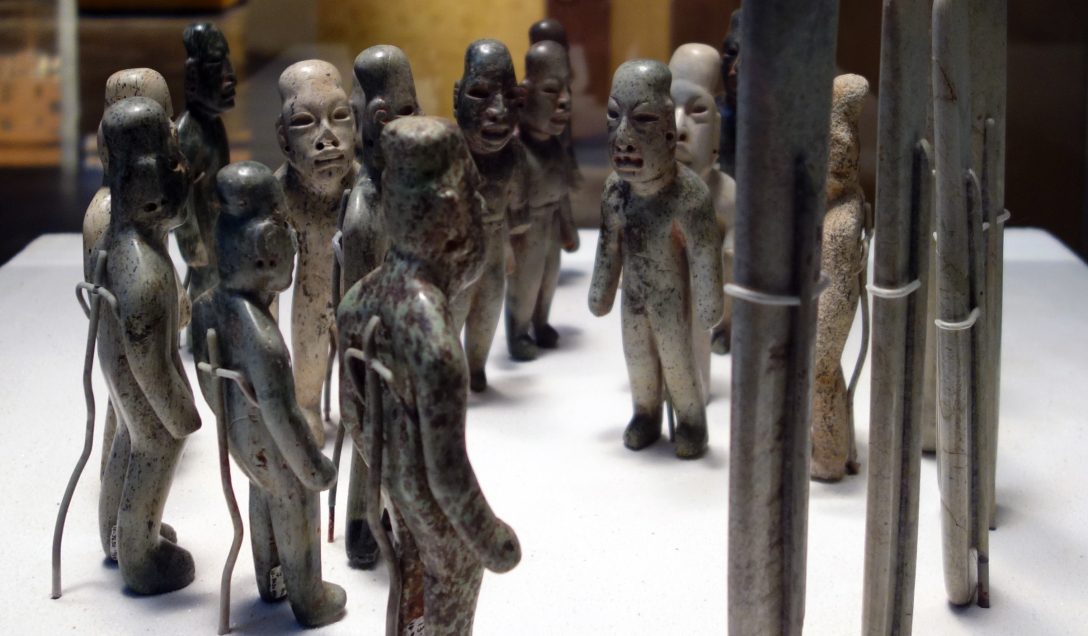
Ceramic figures in energetic poses and with lively expressions were made in the Ameca Valley, Jalisco. Like other West Mexican works of art, they were intended as offerings in tombs. The range of subjects depicted by these sculptures includes gesturing individuals whose hand positions communicated well-established meanings. This sign language has yet to be described and interpreted, but such excited figures may well be recounting

Standing Figure of a Mother and Child 100 BCE-250 CE

Standing Male Figure Holding a Ball, 100 B.C./A.D. 300

Open-Necked Vessel in the Form of a Human Head, Possibly Deceased, c. A.D. 200

Seated Maternity Figure, 100 B.C./A.D. 300

Seated Female Figure, c. A.D. 200

Seated Female Figurine with Elongated Head, 300 B.C./A.D. 300

image

Standing Male Figurine Wearing a Necklace and Breechcloth, 500/300 CE

image

Standing Female Figurine; 500/300 CE

image

Female Figurine 500/300 CE

image

Female Figurine 500/300 CE

image

Vessel in the Form of a Figure with Geometric Face and Body Paint 500 BCE-200 CE

image

Female Figure with Bold, Geometric Face and Body Paint 200/100 B.C.

A rare work of art such as this female figurine, from a time and place far different from ours, may sometimes strike the eye in a way that brings to mind an almost familiar yet elusive sense of recognition as if an essential memory were already there, waiting to rise in the viewer’s imagination. Our approach to such objects can seldom rely on ancient written records. We must begin by looking at the works themselves: at their materials and modes of manufacture, and at shapes, colors, patterns, and symbols. Archaeological contexts can also offer vital information, and analogies may be drawn from the cultural records of later societies in which ancient customs and ways of perception have long persisted.


This sculptural effigy belongs to the sophisticated Chupícuaro artistic tradition, which was more concerned with symbolic abstraction than naturalistic anatomical proportion. The female figure stands in a formal frontal pose, the oversize head set with staring, lozenge-shaped eyes, the nose jutting forward above a receding chin, and the open mouth showing rows of teeth. Subtly concave in the middle, the trapezoidal torso abruptly swells in the bulbous hips, belly, and thighs. The face and body are covered by burnished, deep red slip, or liquid clay, which sets off a bold pattern of cream zigzag lines; more delicate designs were drawn across the cream-painted loins and thighs. There is an uncanny visual quality to the hieratic stance, stylized proportions, and brilliant designs, all of which reflect the ritual body paint that Chupícuaro women would have worn on high ceremonial occasions some two thousand years ago.


Located in Mexico’s central highlands, the principal archaeological site of Chupícuaro was on an island in the Lerma River that was submerged by the waters of a dam built in 1946 and 1947. In ancient times, trails along the riverbanks were traveled by lines of porters bearing colorful Chupícuaro pottery for trade with the growing metropolis of Teotihuacán, far to the east in the Valley of Mexico. Yet impressive Chupícuaro figures like this one were recovered from the now-inundated homeland burial grounds. It is likely that this and several known related figures commemorated a girl’s coming of age, embodying a perceived correspondence between the stages of human life and the earth’s annual cycle of birth, death, and renewal. As burial offerings, these effigies would have affirmed the matriarchal status of a high-ranking, mature, and productive member of society, recalling her initiation into womanhood and family life, and her active participation in seasonal rites devoted to securing the fertility of the soil, the abundance of crops, and the well being of the community from year to year.

image

Polychrome Bowl with Geometric Designs and Face in Relief on Shoulder, c. 400 BCE

MEZCALA

image

Mask 300 B.C./A.D. 300

image

Standing Figure 300/100 B.C.

image

Standing Figure; 300/100 B.C.

image

MEZCALA COLLECTION

MAYA WORLD

image

Vessel Depicting a Sacrificial Ceremony for a Royal Accession (650-800 CE)


This vessel, used to consume a chocolate drink, depicts a key event in a royal Maya accession ceremony, which shows the relationship between human sacrifice and the assumption of power. The expectant king is flanked by servants, musicians, and masked nobles, while a terrified captive—bound to a scaffold—awaits his death. It is probable that the victim was a warrior from a rival community defeated by the prospective king during a coronation war. Such sacrifices were required as proof of a new ruler’s military abilities, provided an offering to his patron gods, and served as a sign of the triumphant reign to follow.

image

Vessel of the Dancing Lords (750-800 CE) Guatemala

According to ancient Maya belief, after several failed attempts the gods succeeded in populating the earth when they created humanity out of maize, the staff of life. In the Popol Vuh, a sixteenth-century epic of the K’iche’ Maya, the death and resur¬rection of the maize god was likened to seed corn that sprouted and produced new life. This vessel from the Late Classic period (600–800) depicts a Maya ruler attired as the maize god in three almost-identical panels. On his back, the ruler wears an enormous rack containing brilliant feathers, heraldic beasts, and related emblems. Just as maize plants sway to and fro, the maize god dances to the rhythm of life—often, as seen here, in the company of a dwarf. Among the Maya, dwarfs were seen as special beings with powerful spiritual connections to the earth and the interior world below. This vase refers to a rite of passage in which dwarfs assist the soul of the deceased into the domain of the dead, from which it would eventually be reborn in the royal lineage, just as maize sprouts again in the cycle of nature’s renewal. This vase of the Dancing Lords may have been painted as a funerary offering for a noblewoman with dynastic connections in the city of Naranjo, where it was made.

image

Vessel Depicting K’awiil (God K) and Itzamna Exchanging Gifts, (700/800 CE)

image

Cylindrical Vessel (250-900 CE)

image

Carved Vessel Depicting a Lord Wearing a Water-Lily Headdress, (600/800 CE)

image

Vessel Depicting a Mythological Scene (600-800 CE)

image

Water-Lily Vessel (750-800 CE)

The simple, elegant design of this vessel reflects the refined abilities of the artist, who painted images of water lilies and a hieroglyphic text with a perfectly controlled brush. The inscription below was the first to be deciphered on a Classic Maya vessel. It states the name of the artist, Ah Maxam (aj maxam), and declares that he is a member of the royal lineage of the kingdom of Naranjo. His mother and father are also named on this vessel, as well as on other dynastic monuments from the region. For the Maya, water lilies were symbolic of the watery surface of the Underworld and the earth’s regenerative powers.

image

Vessel (600-800 CE)

image

Tripod Vessel Depicting Monkey Hunters and Traders  (850/950 CE)

image

Vase Depicting a Courtly Scene (600-800 CE)

image

Tripod with Knotted Motif (850/950 CE)

image

Footed Jar Incised with Pseudo-Gylphs (250/600 CE)

image

Figure of a Standing Warrior (650/800 CE)

Jaina
The costume and equipment of this figure indicate that he represents a warrior. He carries a rectangular shield and a long wooden spear (now lost), and the detailed attention given to the intricate headdress and facial features—marked by scarification, tattoos, and paint—suggests the portrait of a specific military commander.

image

Figure of an Aristocratic Lady (650/800)

Jaina

image

Royal Profile (650/800)

image

Standing Male Figure (650/800)

Jaina


Naturalistic Jaina figures often present detailed portraits of individuals. Men and women are delicately modeled in the poses, gestures, and costumes of those who ruled the Yucatán peninsula at the height of Classic Maya civilization, providing insight into their roles, status, and concerns. While most figures depict the social elite, such as ladies of the court, royal ballplayers, and priests, some also reflect interest in the range of Maya society members, including servants and captives wounded in battle.

image

Rattle in the Form of a Mythological Figure (650/800)


Jaina


Many of the hollow interiors of mold-made Jaina figurines were transformed into rattles or whistles. As musical instruments, they may have been played during the funerary ceremonies of the deceased whom they accompanied into the afterlife.

image

Ritual Vessel in the Form of a Head (600/900)
Yucatán

image

Figurine (250/900)
Mexico, Guatemala, or Honduras


image

Figure of a Jaguar Attacking a Man (Probably 250/900)
Possibly Tabasco, Mexico

image

Whistle in the Form of the Head of a Jaguar (Possibly 250/900)
Possibly Jaina-style
Possibly Campeche, Mexico

image

Covered Vessel with the Principal Bird and Peccary Heads (200/300)


Petén region, Guatemala


This beautifully modeled and incised blackware vessel was likely was once the personal possession of a Maya king, who may have used it to serve food at royal feasts or who may have presented it as a gift to a visiting lord as a sign of alliance. Its shape—a lidded dish supported by four legs—was a form frequently produced during the Early Classic period [A.D. 250/450]. These ceramics often display a consistent set of motifs, with birds on their domed lids and inverted peccary (wild pig) heads serving as supports. The artist who created this piece integrated the two-dimensional surface of the lid with its three-dimensional handle by connecting the bird’s spread wings, lightly incised into the surface, with its head, sculpted in the round. The vessel thus captures the essence of an aquatic bird floating on the surface of the water with its prey—a small fish—caught in its open beak.
Water birds and peccaries inhabited the natural landscape of the ancient Maya who associated them with the structure of the universe and the time of creation. The crest of feathers atop the bird’s head, its outstretched wings, and the bulge at the tip of its beak mark it as a cormorant. The Maya regarded this bird as a liminal being, able to traverse three distinct environments: it flies in the sky, perches on land, and hunts fish by swimming deep under water. This was considered extraordinary, signifying the capacity to commune with supernatural beings that inhabit all three layers of the cosmos—a power that Maya kings also claimed to posses. The cormorant bore many additional meanings with which these rulers wished to link themselves—for example, its association with watery realms alludes to fertility and agricultural abundance, which kings needed to ensure so that their community would survive. Water also evoked the distant mythological past, a time before the creation of the present universe when, according to Maya belief, everything was enveloped in a vast sea. The peccaries furthered these cosmic associations as they are thought to have represented the four pillars that support the corners of the world. In addition, some Maya identified clusters of stars in the constellation Gemini as peccaries. This constellation is located in the region of the night sky where the seminal event of Maya creation—the resurrection of the maize god—was believed to have occurred.
All of these formal and iconographic features demonstrate that as a vessel made for a ruler and used in his court, this work was adorned with imagery designed to express the supernatural sources of his royal authority. In their art programs, Maya kings often associated themselves with the cosmos and the time f creation, thereby affirming that their right to rule was inherent in the world and was established at the beginning of time.


image

Plate Depicting a Dancing Figure (600/800)
Possibly Petén region, Guatemala

image

Plate in the Form of a Jaguar with Interior Painted with Floral-Like Motif (200/700)

image

Stamp (300 B.C./A.D. 250)

image

Eccentric Flint (200 CE)

image

Ballplayer Panel (700/800)


Usumacinta River area, Mexico or Guatemala


In Central America, the best-known sculptors are the Maya, who decorated their temples and sacred precincts with finely carved stone reliefs representing powerful dynastic rulers involved in various secular and religious activities. This fragmentary ball-court panel from the late eighth century shows two men, dressed in elaborate costumes, engaged in a ritual ball game. Surrounding the figures, and clearly set off from them, are fragments of hieroglyphs by which the Maya identified the players and the date on which the game occurred.

image

Stela (702 CE)

Vicinity of Calakmul, Campeche or Quintana Roo, Mexico

The lords of Maya city-states in southern Mexico, Guatemala, Belize, and Honduras portrayed themselves on stone monuments called stelae. Placed in plazas before the palaces and pyramids of ritual and administrative centers, these sculptures document critical information about major dynastic events between A.D. 200 and 900, including royal inaugurations, military triumphs, marriages, deaths, rituals, and key events of the agricultural cycle).
The carving style of the stela suggests that it may be from the vicinity of Calakmul, a major Classic Maya city located in Mexico’s Yucatán Peninsula, close to the border with the Petén district of Guatemala. A male figure—likely a ruler—stands in a frontal position, with his head, lower legs, and feet (now missing) turned to the viewer’s left. The subject’s gaunt face suggests that he is elderly. He holds a double-headed serpent bar across his body and is dressed in ceremonial attire associated with the Maize God, consisting of a plumed headdress, jade jewelry, a jade-netted kilt, and a spondylus seashell below the midriff. This costume symbolically connected the ruler to the earth, sky, water, and maize (corn).
Hieroglyphics carved on the left side of the monument record the date 9.13.10.0.0 in the Maya calendar, corresponding to January 26, A.D. 702, which marked the completion of a Maya 10-year period. The text on the right side documents the ritual auto-sacrificial bloodletting performed by the ruler to commemorate this significant moment in time. Although they are too highly eroded to read accurately, the hieroglyphs on the front of the stela likely name the ruler, his ancestry, and the place where he governed.

image

Hieroglyphic Altar (650/700)


Possibly Bonampak/Lacanha area, Mexico or Guatemala


This altar depicts the head and torso of an individual wearing an ornate headdress and a large, woven mat pectoral emblem of rulership. He appears within a four-lobed cartouche, suggesting that he is a deceased ancestor who lives in the Underworld. The hieroglyphs that surround the figure describe the commemoration of a monument or structure; the text carved around the sides of the monument celebrate a successor’s completion of six years of kingship.

image

Hieroglyphic Panel (650/800)


Usumacinta River area, Mexico or Guatemala


The Maya developed hieroglyphic writing to record the names, births, marriages, alliances, victories and coronations, and deaths of their rulers. Mythological events and religious happenings were also carefully chronicled. Today scholars are deciphering this script and linking the translated information to additional archaeological evidence in order to reconstruct ancient Maya history, belief, and culture. This fragment from a hieroglyphic panel contains calendrical information that was part of a longer text.

image

Pectoral (200/800)


This elegant chest ornament would have been part of a ruler’s ceremonial regalia. In Maya society, as among other Amerindian peoples, a ruler’s attire indicated rank, religious function, and place of origin. Such dress was highly regulated, and only members of the nobility wore jade and other greenstones as an expression of their wealth and high status. Moreover, these rare and valued stones were considered to be inherently sacred and powerful. By wearing jade regalia, kings directly associated themselves with the youthful green maize plant and life-giving blue-green waters.

image

Ear Spool (250/900)

image

Labret (200/700)

image

Pair of Ear Spools (250/900)

image

TRIPOD VESSEL (100-300 CE)

image

Shell, Possibly an Arm Band, Incised with Profile Head Framed by Geometric Motifs (1200 CE)

image

Miniature Mask; Wood, gold foil, and shell with pigment and resin (1300-1400 CE)

Mosaic Disk with a Mythological and Historical Scenes (Turquoise, earthenware, stucco, spondylus shell, mother of pearl, and iron pyrite, with pigment) 1400-1500 CE


On this disk, the sign for “year” and the date “3 Flint- Knife” (A.D. 1456) are associated with the image of the sun on the left; the date “4 House” (A.D. 1457) is linked by footsteps to the sun on the right. These dates mark the end of one 52-year cycle and the beginning of a new one. In the center, crossed darts symbolize a military alliance. Alliance members are represented by the skeletal figure at the left and the animal figure at the right. Below, a prone human form (damaged) signifies a sacrifice to confirm the association. The imagery of the disk stems from a long-established Mixtec tradition of pictorial manuscripts.

CORONATION STONE OF MOCTEZUMA II

STONE OF THE FIVE SUNS (1503)

image

RITUAL IMPERSONATOR OF XIPE TOTEC (1450-1500)

image

XILONEN; GODDESS OF YOUNG MAIZE (1450-1500)

image

EAR FLARE WITH FLOWERED MOTIF (1450-1521)

image

SPINDLE WHORL (1450-1521)

image

FLOWER SHAPED EAR ORNAMENTS (1450-1500)

image

EAR ORNAMENT; FROG MOTIFS (1450-1521)

image

SPINDLE WHORL (1450-1521)

image

EAR ORNAMENT (1450-1521)

image