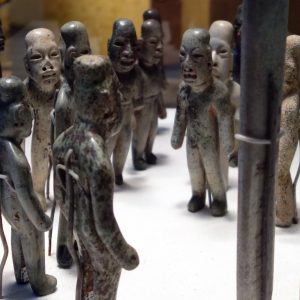
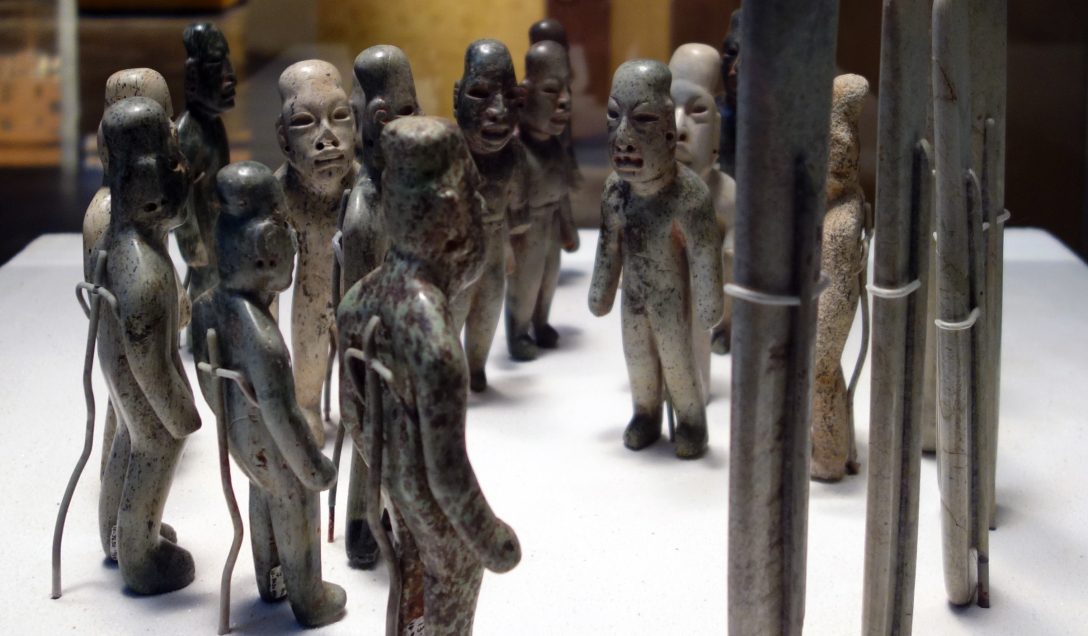
In the Gulf Coast lowlands of Veracruz and Tabasco between 900 and 400 B.C., Olmec rulers built cities with ceremonial earthen pyramids, platforms, and plazas. Monumental sculptures depict rulers and mythological themes, while small-scale figurines and related works commemorate important events. This figurine was found near the Coatzacoalcos River during the 1960s. It is carved in the style of figurines from a ritual offering at the major capital La Venta. These may have marked a rite of passage, when young men were initiated into office as rulers, warriors, priests, or traders in the stratified Olmec society.
EXAMPLES
Seated Female Figure 800/400 B.C.
Mask 200 B.C./A.D. 300
Cup with Profile Head of the Maize God 800/400 B.C.
Mural Fragment Representing a Ritual of World Renewal Date: A.D. 500/600 The ancient Mexican city of Teotihuacan was once the largest city in all of the Americas. The pomp and color of this great city were expressed most distinctively through its monumental architecture. Facades of pyramids and interiors of palaces, temples, and homes were frequently decorated with splendid frescoes. The fragment shown here was part of a cycle painted on the interior walls of an aristocratic palace. It shows a rain priest walking or dancing in profile and wearing an elaborate headdress and costume. His speech-scroll, adorned with seashells and plants, indicates that he is praying for water and agricultural prosperity, which were highly valued in his society.
Meaning “place of the gods,” Teotihuacan was the largest religious, military, and trading city in the Americas between A.D. 200 and 650, and it was inhabited by over one hundred thousand people at its peak. Designed with colossal pyramids and ritual plazas, the metropolis was built on a cosmologically oriented grid plan that embraced residential and manufacturing districts. This richly symbolic fragment from a Teotihuacan wall fresco depicts a ceremony that took place once every fifty-two years, a “century” in the ancient Mexican calendar system. A priest stands before a tied bundle of reeds representing the completion of a cycle of time. The bundle is impaled by the spiny points of maguey cactus leaves, with which the priestly protagonist of the scene has pricked himself to provide a blood offering. Water symbols in the form of shells and flowers are depicted within the speech-scroll curling from the priest’s mouth. Additional flowers and water are sprinkled from one of the priest’s hands, while in the other he holds an incense bag. Corresponding to the chants of a religious litany, this complex image was repeated with others on the walls of a chamber as a prayer of thanksgiving and for the renewal of agricultural fertility.
Mask from an Incense Burner Portraying the Old Deity of Fire A.D. 450/750
Shell Mosaic Ritual Mask AD 300/600 Teotihuacan, the ruins of which are located near Mexico City, was one of the largest and most complex cities in the world during the first millennium AD. Although this mask shares features common to others from the city—a broad forehead, prominent nose, receding chin, and widely spaced cheekbones—it is subtly unique, indicating that it may represent a stylized portrait. Tied to wooden armatures adorned with feathers, jewelry, and garments, such masks were displayed in residential compounds and temples where they were the focus of rituals commemorating ancestors who acted as intermediaries between the living and the deified forces of nature. An older, recut stone mask was covered with mosaic tiles made from the inner layer of spondylus shell imported from the Pacific coast. The use of this exotic material suggests the far-reaching power, author¬ity, and wealth of Teotihuacan. Spondylus was also considered sacred, associating this mask and the individual it honors with the generative power of lakes, rivers, and the sea.
Ritual Mask A.D. 300/750
Bowl Depicting a Ritual Figure and Flaming Torches A.D. 300/600 Teotihuacan ceramic vessels were often fired and coated with a fine plaster that was then painted with figures and symbolic elements. This technique was derived from methods employed by mural painters, who covered masonry walls with fine plaster to serve as the ground for large-scale frescoes. The flaming torch may well allude to the ceremony of New Fire, kindled at New Year’s festivals and every 52 years at the inauguration of a new “century” in the native calendar system.
Tripod Vessel with a Blowgunner Scene A.D. 300/500
Mirror with Jaguar or Coyote Mosaic Date: A.D. 500/600
For over 2,000 years, polished stone mirrors were an important component of Mesoamerican attire, ritual, and symbolic imagery. This mirror is made of a single sheet of polished pyrite stone and includes a jade jaguar mosaic at its center. Mirrors often functioned as emblems of rank and office and were typically worn at the small of the back. The depiction of such mirrors in ancient murals, as worn by warriors, priests, and state officials, attests to their importance in the spectacular art of ritual performance in Teotihuacan.
Figure of a Seated Leader A.D. 300/600 This naturalistic figure ranks among the finest works of the Remojadas sculptural tradition. The artist modeled the face of a youthful chieftain as an idealized type, yet there is also a sense of individual portraiture. Sitting cross-legged, with arms extended to the knees, the young ruler’s body conveys tension. He is elegantly dressed with an elaborate turban, belt, and skirt. The jewelry adorning his wrists and neck represents flowers, while the embroidery of the belt likely signals his rank and status. Sophisticated clay technology was used to create this masterpiece. The head and neck were modeled separately and fitted into the top of the body, with soft clay added to smooth and strengthen the seam. The arms and legs were made of hollow tubes, while the flowers and belt ornaments were prepared from small bits of clay pressed to the moist surface. After the assembled figure completely dried, it was fired. The naturalistic rendition of the human form, close attention to human expression, and technological command of the material attest to a mature artistic tradition and an accomplished sculptor.
Portrait Head A.D. 250
VERACRUZ
Ceremonial Ballgame Yoke A.D. 700/800
Played throughout Mesoamerica, the ceremonial ballgame was a sport as well as a ritual substitute for war in which sacrifice was often the final outcome. Players were required to propel a heavy rubber ball with their hips, thighs, shoulders, and lower arms. A yoke, made of padded leather or wood, was worn at mid-body to protect the torso and direct the ball. Carved stone yokes were intended as ceremonial emblems or trophies and were not used in actual play. At least eleven ballcourts have been discovered at El Tajín, suggesting that the city may have been a sort of Olympic center as well as a ruling capital.
Fragment of a Ceremonial Ballgame Yoke A.D. 700/800
Figure Carried in a Litter A.D. 600/950
Dancing Figure Wearing Animal Headdress and Ornate Costume A.D. 600/900
Standing Warrior Figure with Removable Mask and Headdress A.D. 700/1000
Ballplayer Figurine A.D. 800/1400
Ballplayer Figurine A.D. 800/1400
Figure of a Woman in Ceremonial Dress A.D. 700/900 In the afterlife, it was the role of deceased noble ancestors to communicate with the deified forces of nature on behalf of their people. Presented as offerings at ancestral shrines, mold-made figures of this kind were sometimes reshaped while the clay was still moist to give them more individualized facial features.
Polychrome Plate Depicting a Standing Figure with Ornate Speach-Scroll A.D. 600/900
Tripod Polychrome Bowl Depicting a Serpent with Scales and Feathers and Fluid Motifs A.D. 500/750
Vessel in the Form of a Seated Hunchback 100 B.C./A.D. 250
Figure of a Seated Chieftain 100 B.C./A.D. 250
Seated Warrior Figure with Turtle Headdress, Holding a Staff 100 B.C./A.D. 250
Warrior with Headress and Shield 200 B.C./A.D. 200
Standing Male Figure Holding a Plate A.D. 100/400
Seated Male Figure with One Arm Raised A.D. 100/900
Seated Female Figure Holding a Vessel A.D. 100/400
Seated Female Figure Holding a Bowl A.D. 100/800
Female Figure c. A.D. 200
Seated Female Figure Giving Birth c. A.D. 200
Seated Figure Drinking from a Vessel using a Tube 200 B.C./A.D. 300
Figure of a Dog A.D. 1/200
Figure of a Seated Dog A.D. 1/300
Vessel in the Form of a Calabash A.D. 1/200
Fluted Vessel, Possibly in the Form of a Gourd
c. A.D. 200
Parrot Vase c. A.D. 200
Miniature Figure in the Form of a Bird with Exaggerated Tailfeathers c. A.D. 200
Ceremonial Knife c. A.D. 200
Ceremonial Blades c. A.D. 100
Necklace 200 B.C./A.D. 200 Figures and jewelry made of spondylus (spiny oyster) shell developed as a specialization in what are today the Mexican states of Colima and Jalisco. Like greenstone, jade, and colorful feathers, this bright orange shell was a luxury item sought by maritime merchants from Ecuador and Central America, who found it in warm Pacific waters as far north as the West Mexican coast. As emblems of authority and status, exotic materials were displayed by rulers during ceremonial events. Spondylus-shell jewelry carved with symbolic designs found in West Mexican tombs indicates the high esteem in which this valued material was held.
Necklace with a Pendant Depicting a Large Fish Eating a Smaller Fish 200 B.C./A.D. 200
Pendant in the Form of a Mythical Double-Headed Creature 200 B.C./A.D. 200
Circular Pendant 200 B.C./A.D. 200 Figures and jewelry made of spondylus (spiny oyster) shell developed as a specialization in what are today the Mexican states of Colima and Jalisco. Like greenstone, jade, and colorful feathers, this bright orange shell was a luxury item sought by maritime merchants from Ecuador and Central America, who found it in warm Pacific waters as far north as the West Mexican coast. As emblems of authority and status, exotic materials were displayed by rulers during ceremonial events. Spondylus-shell jewelry carved with symbolic designs found in West Mexican tombs indicates the high esteem in which this valued material was held.
Pendant Depicting a Seated Figure 200 B.C./A.D. 200 Figures and jewelry made of spondylus (spiny oyster) shell developed as a specialization in what are today the Mexican states of Colima and Jalisco. Like greenstone, jade, and colorful feathers, this bright orange shell was a luxury item sought by maritime merchants from Ecuador and Central America, who found it in warm Pacific waters as far north as the West Mexican coast. As emblems of authority and status, exotic materials were displayed by rulers during ceremonial events. Spondylus-shell jewelry carved with symbolic designs found in West Mexican tombs indicates the high esteem in which this valued material was held.
Necklace 200 B.C./A.D. 200
Pendant in the Form of a Clamshell A.D. 1/800
Long-Stem Pipe c. A.D. 200
Sculpture in the Form of a Conch Shell, Possibly a Trumpet 200 B.C./A.D. 200
Large terracotta figures were made to accompany the remains of high-ranking people in ancient West Mexican tombs. Figures are often found in male-and-female pairs, likely commemorating the marriage of the deceased. Nayarit artists also depicted other major rites of passage, such as the presentation of a baby, the initiation of warriors and chiefs, young women reaching the age of courtship and marriage, and funerary rites. Such tomb figures testified to the earthly status of the deceased, qualifying the individual as a venerable ancestor-spirit expected to intercede with cosmic forces on behalf of the living community.
Seated Joined Couple 200 B.C./A.D. 300
Standing Female Figure A.D. 100/300
Figure of a Seated Female 100 B.C./A.D. 500
Seated Figure Playing a Rasp c. A.D. 100
Seated Female Figure Holding a Bowl on Her Lap
100 B.C./A.D. 300
Seated Male Figure Leaning Forward with Arms Crossed over Knees c. A.D. 200
Polychrome Standing Figure with Exaggerated Head and Hips A.D. 1/300
House Model with Ritual Feast 100 B.C./A.D. 300
Model Depicting a Ritual Center A.D. 100/800 In West Mexico, chiefdoms and statelike societies flourished between A.D. 100 and 800. Advanced agriculture, extensive trade routes, and elaborate religious festivals echoed developments in other regions of ancient Mesoamerica. The distinctive West Mexican sculptures were often included as offerings in tombs that illustrate important themes of life and the afterlife. This model of a circular ceremonial center depicts houselike temples, populated by flute players, a drummer, conch-shell trumpeters, dancers, women with children, and animals. A masked figure—likely the ruler—stands atop the central stepped pyramid.
Funerary Cheek-Piercing Ritual 200 B.C./A.D. 300
Model of a Tree-Climbing Ritual A.D. 100/800
House Model Depicting a Ritual Feast 100 B.C./A.D. 300



 MIKE RUGGERI'S ART INSTITUTE ANCIENT AMERICAS